Sudan Fast Facts:
Population:
49.3 million
Number of people groups:
200
Unreached people groups:
169
Largest religion:
Islam (93.4%)
Evangelical Christian:
.48%

When shots rang out on the morning of April 15, 2023, Faheem*, a missionary with a local ministry ordered his family to hit the floor. Tensions remained high in Sudan after the alliance between two military generals fell apart two years earlier, and Faheem wasn’t taking any risks.
On this particular day, Faheem assumed the conflict would pass quickly, as seemed to be the case lately. But a few days passed, and he began to suspect that, this time, the situation was different. “We were all surprised at how the tension between the two groups escalated into war,” Faheem said. “No one was prepared for such circumstances.”
The conflict intensified with alarming speed, and Faheem knew his family had to leave. “Three days after it began, my family and I found a way out,” he said.
“We left everything behind.”
They journeyed 10 hours by bus to another, safer city. Soon after their arrival, they learned that their entire town, including their own home, had been looted. “We left everything behind,” he said. “All we brought was a pair of clothes for each of us.”
Faheem and his family weren’t the only Sudanese who fled to this particular city, and resources soon began to grow thin. Realizing things were deteriorating, Faheem and his family traveled again. This time, they went to Ethiopia and, eventually, to Uganda. “Thank God for saving us,” he said.
But millions of others were stuck. And now, nearly two years later, they are victims trapped in the middle of a full-blown civil war with no end in sight. They are homeless. They are fearful. And they are starving.
The Collapse of a Nation
In 2019, the Sudanese rejoiced when Omar al-Bashir, the leader of Sudan, was removed in a coup. They were hopeful Sudan could return to a civilian government after decades under his authoritarian rule. But two years later, their hopes were dashed when two military generals—Abdel Fattah al-Burhan and Mohamed “Hemedti” Hamdan Dagalo—fell out of favor with one another. As a result, the transitional civilian government was dissolved as their conflict escalated into the present-day civil war.
Today, fighting between Sudan’s Armed Forces (SAF), led by al-Burhan, and the Rapid Support Forces (RSF), led by Hemedti, has displaced 11.5 million people, including 8.5 million who have been displaced within Sudan and 3 million who, like Faheem and his family, fled to neighboring countries, according to the UN Refugee Agency (UNHCR).
“The stability of the whole region hangs in the balance.”
“This brutal war has uprooted millions of people, forcing them to leave their homes, schools and jobs behind in search of safety,” said Filippo Grandi, UN High Commissioner for Refugees. “The stability of the whole region hangs in the balance.”
But Worse Days Are Yet to Come
Displacement isn’t the only—or perhaps the worst—crisis the Sudanese now face as a result of this war. Not only has the country’s healthcare system collapsed as a result—with maternity wards forced to close after they were shelled—but famine has begun to stretch across Sudan like a spiderweb.
“The war in Sudan has created the worst humanitarian crisis on Earth.”
More than half of the population, nearly 25 million people, are suffering from severe hunger. “The war in Sudan has created the worst humanitarian crisis on Earth,” said Linda Thomas-Greenfield, Ambassador and Permanent Representative of the US to the UN. “…the country is on the verge of a generational famine.”
How You Can Help
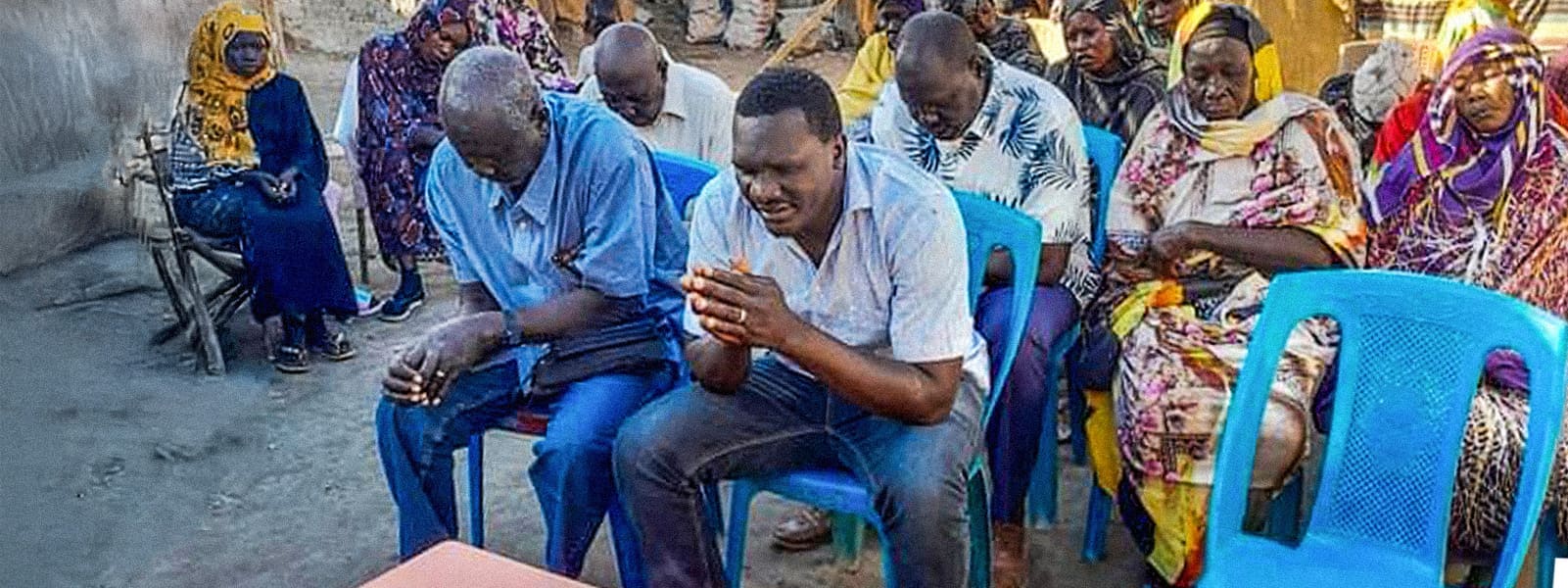
Workers from one local ministry that you support are not only serving those displaced within the country, but they are also helping those who have fled to other countries, as the need for basic assistance remains at critical levels.
“The need is in many places outside and inside Sudan.”
“The war in Sudan has created a more complex humanitarian situation than ever before,” the ministry leader said. “The need is in many places outside and inside Sudan. We have distributed lentils, oil, sugar, rice, flour, tea, vermicelli, and pasta. And through our compassionate acts of mercy, the team expresses our Christian faith.”
Please consider a donation today. The need for basic necessities will only grow as the civil war stretches on, and your financial assistance will help this ministry and others in North Africa serve those who have lost everything.
And please pray for these missionaries as they serve. “We believe in the One who said, ‘I will never leave you nor forsake you,” the ministry leader said. “But pray for our team who still remains in Sudan. They face a lot of danger.”